
How to rank on Google: a practical guide for your website

«SEO is not a bag of tricks. It's an iterative process that compounds over time — if you apply it with a clear method.»
Ranking organically on Google means that your page appears in search results because Google considers it the best answer for a particular query, not because you paid for the click. To get there, you need to do two things right: Google understands your website and people find what they're looking for on it.
This guide walks you through the entire process, step by step, with clear criteria for each decision.
What it means to rank on Google (and what it isn't)
When someone searches for how to appear on Google, they usually mix two different concepts:
- Organic positioning (SEO) is about improving your technical and content relevance for specific queries. The results come with time, but they last.
- Paid advertising (SEM/Google Ads) buys immediate visibility. It is effective for launching products or capturing quick demand, but it depends on the budget.
Neither replaces the other; Many strategies combine both depending on the business objectives.
An important clarification: appearing is not the same as converting. What matters is that your page appears for the right searches, satisfies the user's intent, and delivers an experience that's consistent with what they were looking for.
The SEO process with method: 5 repeatable phases
SEO is not a set of tricks. It's an iterative process that gets better over time if you apply it in an orderly manner. These are the five phases:
Phase 1. Define objectives and context
Before touching on anything technical, clarify what you want to achieve: capture informational searches to make your brand known? Show up for transactional queries from people ready to hire? Strengthen the thematic authority of your sector?
Without this clarity, keyword and content work becomes an exercise in guessing.
Phase 2. Keywords and search intent
Search volume matters, but intent decides. Classify your queries into three groups:
- What it is, how it works, guides and definitions: Informational
- Alternatives, differences, analysis to make decisions: Comparisons
- Price, contract, service, availability, local searches: Transactional
Each group needs a different type of page. Mixing intents into a single URL often worsens the outcome.
Phase 3. Content and architecture
Create pages that truly respond to the intent detected. Don't write for the sake of it: build pages that a user finds useful and that Google can understand and relate to your topic.
Architecture is just as important as content: if Google can't discover your pages or doesn't understand how they relate to each other, the best article may run out of visibility.
Phase 4. Technical SEO and User Experience
Without a solid technical foundation, content does not reach those who need it. Control at least: indexability, loading speed, mobile compatibility, and consistent internal binding.
Phase 5. Authority and measurement
Authority is built with relevant links from sites in your industry or related context. Measure in Google Search Console and Analytics to identify what's working, what needs improvement, and where the opportunities you haven't captured yet are.
Here’s a handy infographic on the five stages, which makes for a useful quick reference: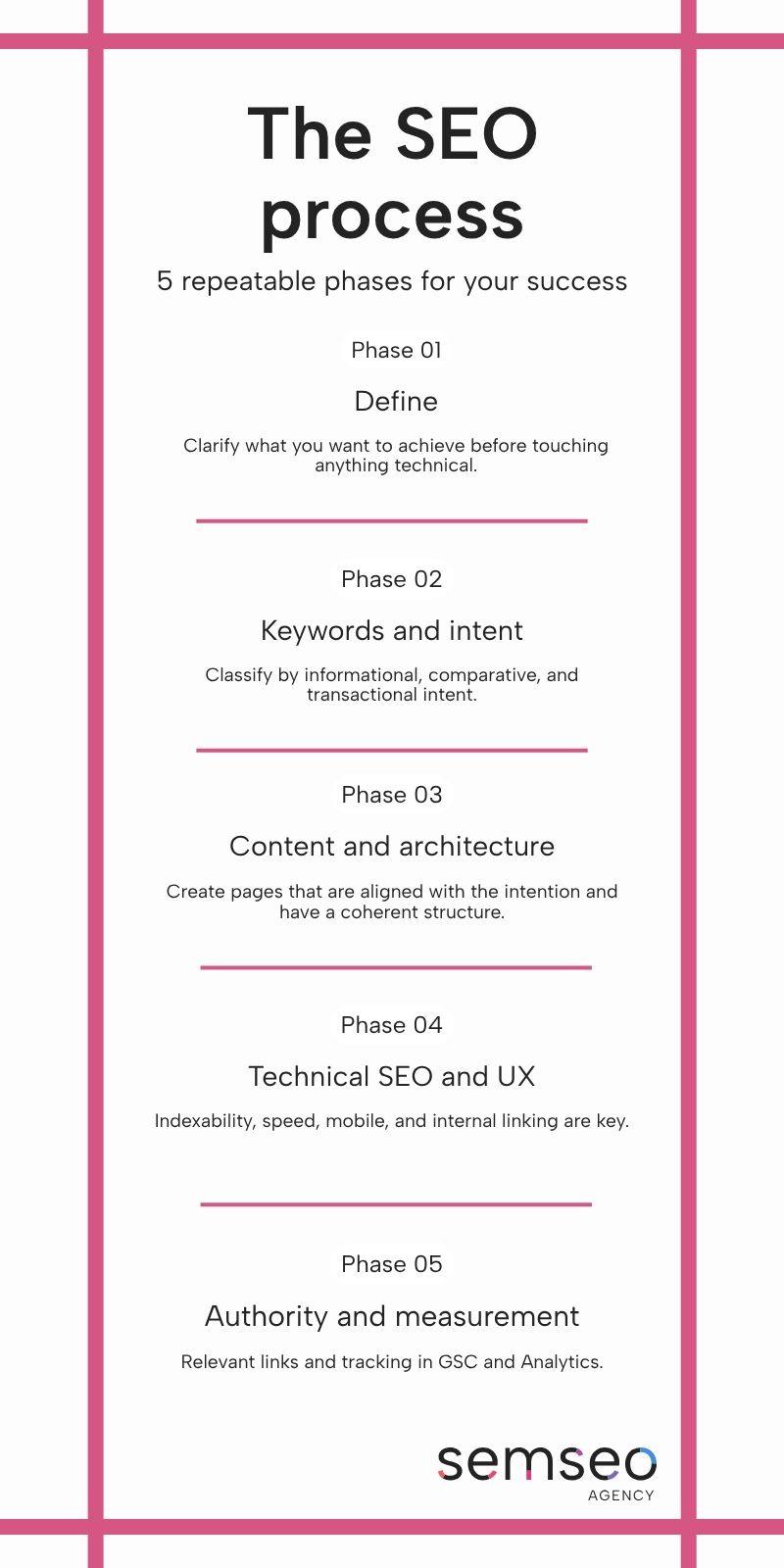
Keywords: how to choose them without making the most frequent mistakes
Choosing keywords is one of the most wasted steps. Some common mistakes:
- Choose keywords by volume without checking the real intention of the searcher.
- Attacking terms with very high competition when your website does not yet have the necessary authority.
- Create multiple pages for variations of the same term (cannibalization).
A practical way to structure work is to define "pillar" pages (which address the central theme of a service or category) and "satellite" or support pages (which develop specific subtopics and link to the pillar). This improves the topical understanding of your website and prevents multiple URLs from competing with each other.
What you don't need to do: force every possible variation of a keyword into the same text or worry about capturing every long-tail imaginable. Google's systems understand synonyms and semantic variations. What you do need is to respond well to the main intention of the query.
Content and architecture: the two sides of the same process
Content and architecture are mutually reinforcing. You can have the best article in the industry, but if no one links to it internally and Google doesn't know how it relates to the rest of your website, its impact is limited.
What makes content rank well
- It responds to the complete intention of the seeker: not only the direct question, but also the related doubts that arise sooner or later.
- It has a clear structure with headings that guide the reading.
- It provides something that the user does not easily find elsewhere: its own data, expert perspective, concrete examples or a clear synthesis of scattered information.
- It is updated when the theme evolves, because SEO is not static.
What Makes an Architecture Work
- Internal linking with context: not links for the sake of linking, but because the landing page expands or complements what you're explaining.
- Consistent thematic structure: groups content by service, category, or stage of the user's journey.
- No duplicate content: Having the same information across multiple URLs hurts the user experience and can cause search engines to crawl pages with no real value.
A simple red flag: if a user arrives at your page and in the first few seconds doesn't find what they expected, your content is not aligned with the intent. This mismatch is detected by Google.
Technical SEO: What Your Website Needs to Be Crawlable and Interpretable
Technical SEO is not about "liking Google". Its goal is to remove the obstacles that prevent Google from understanding your structure and users from navigating frictionlessly. The essential fronts:
- Make sure that the pages you want to rank are indexed and not mistakenly blocked in robots.txt or meta noindex.: Indexability
- Especially on mobile. A slow web makes the experience worse and is one of the factors that Google takes into account: Speed and performance
- Wearable design, without elements that cover up content or generate frustration on small screens: Mobile compatibility
- Menus, breadcrumbs, and contextual links that help you discover content and understand hierarchy: Internal linking and navigation
- When they fit with the type of content (articles, FAQs, products, reviews), they can improve how Google interprets the page.: Structured data
If you're in doubt about what to prioritize, start with what limits crawling and indexing: a basic technical issue overrides any content work.
Authority: How to Get Links That Actually Contribute
A domain's authority is built over time and through links from other sites. But not just any link adds up: what matters is the thematic relevance and the context.
Some effective ways to get quality links:
- Publish original content that others want to cite: own data, studies, reference guides.
- Editorial collaborations with media or blogs in your sector.
- Appear as an expert source in third-party articles.
- Useful resources (tools, templates, comparisons) that others link to naturally.
What to avoid: artificial linking tactics or mentions without context. Google is getting better at detecting inauthentic patterns, and the risk doesn't pay off.
Measurement: how to know if your SEO strategy is working
Without data, SEO is intuition. With data, it is a system of continuous improvement. The two fundamental tools:
Google Search Console
It shows you which queries are driving impressions of your website, how many clicks you get, and for which pages. It's the most direct source for understanding what's working and what needs tweaking.
Signs to check regularly:
- Pages with a lot of impressions, but few clicks, → there may be room for improvement in the title and meta description.
- Queries that you show up for, but didn't expect → content opportunities that you hadn't detected.
- Drops in impressions or position → a Google update or a change in competition that requires a response.
Google Analytics
Complement Search Console with behavioral data: which pages attract visits and which generate the actions you care about (forms, calls, purchases, reservations).
The goal is not to accumulate visits, but visits that do something relevant to your business.
Checklist for your next SEO sprint
This table summarizes the fronts you should review, what to look for in each one, and when to consider that it is going well or that it needs intervention.
Area | What to Review | Positive sign | If it doesn't go well | Priority |
Keywords and intent | Does your page respond to the real intent? | Matches what the user is looking for | Restructures headers and expands coverage | High |
Contents | Do you have a definition, process and examples? | Less bounce, better engagement | Rewrite the aperture and improve readability | High |
On-page | Do title and metadata describe the content? | Best CTR in Search Console | Adjust titles, meta and internal linking | Media |
Architecture | Does the page link to related content? | Google discovers frictionless content | Create clusters and strengthen internal links | Media |
Technical | Are indexability and mobile correct? | No tracking incidents | Fixes crashes and improves performance | High |
Authority | Are the links received thematically relevant? | Gradual improvement of positions | Prioritize real editorial opportunities | Media |
Measurement | Do you have clear KPIs in GSC and Analytics? | Data-driven decisions | Define metrics and review every week | High |
How we work at Semseo to build your SEO plan
When a client comes to Semseo wanting to improve their rankings, we always start by understanding the starting point: what is indexed, what queries are already driving traffic, and what their target audience is really looking for.
From there, the process has four stages:
- Study of keywords by intention and definition of the content structure.
- Technical review: indexability, architecture, speed and mobile compatibility.
- Internal linking and editorial plan to cover the detected intentions.
- Implementation of monitoring and reports to measure progress and adjust the strategy with real data.
The goal is for SEO to stop being blind work and become a measurable system with predictable results.
Frequently Asked Questions
How long does it take for SEO to work?
It depends on the technical state of your website, the competition in the sector and the quality of the content you publish. It is common to see signals (impressions, first position changes) before positions are consolidated. The important thing is to measure from the beginning in Google Search Console to be able to adjust the plan.
SEO or Google Ads? What is best for me?
They are not exclusive. SEO generates long-lasting results with no cost per click, but it takes time. Ads work quickly, but they depend on your budget. The smartest combination depends on your goals, your time horizon, and the resources available.
Is it possible to rank on Google without a budget?
Yes, although "no cost" means investing time. Keyword research, useful content creation, and basic technical improvements are all accessible without paid tools. If time is limited, prioritize the pages with the highest transactional intent: they are the ones that generate results first.
How do I know if my SEO strategy is working?
Check Google Search Console to see if impressions are increasing for the queries you're interested in and if CTR improves when adjusting titles and meta descriptions. In Analytics, validate whether those visits perform the actions you're looking for: forms, calls, purchases, or bookings.
What weighs more: content or links?
Both count, but order matters. If your content doesn't satisfy the search intent, no link is going to save it. Start by improving pages that already have potential (high impressions, low CTR) before pursuing external authority.
Do I need a blog to rank on Google?
It's not mandatory, but it helps. The blog allows you to cover informational intentions and link to service or product pages. If you don't want to maintain a blog, you can create guides and resources within your main structure, as long as they respond to real searches and are well integrated into the architecture.


