
Tips for designing a landing page

«Always focus more on the values of the product or service.»
The landing page plays a central role in any online marketing process: it can collect data about your visitors, increase the conversion rate, get leads, and help you improve search engine rankings.
Anyone who has created a landing page knows that designing it is no easy task: design, usability, and text work together to capture the visitor's attention. And what worked a few years ago doesn't have to work anymore today.
Landing page with an impactful title
The title is the first impression when someone lands on your page. It's worth working well, but at the same time keep it short and to the point, because people don't like to read long, complicated sentences. Focus on the value of the product or service, not on describing yourself.
If you manage to convince the visitor with the title (and the brief introduction that follows) you already have an advantage over your competition.
An effective headline should be clearly focused on the benefit to the user, not the company. The subtitle, on the other hand, should reinforce that proposal and anticipate social proof. That order matters.
Focus on the benefits!
In general, concise, benefit-oriented content works best. The purpose of the landing page is to motivate the visitor to carry out a specific action: buy, request a quote, register... To achieve this, you need to articulate a specific customer problem and position your service as the solution.
Some tricks that work well:
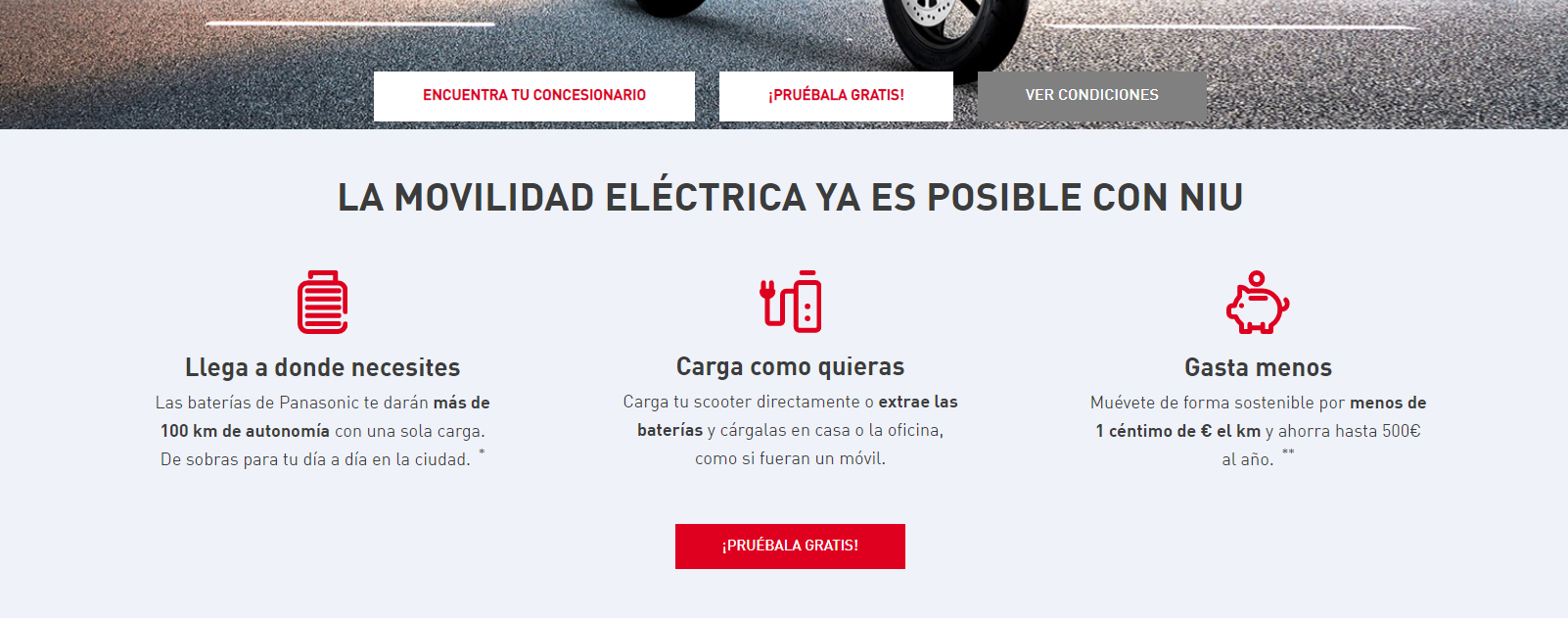
- Benefit-focused content: Support your product's usefulness with clear features. Use eye-catching icons and titles to make it easy to scan.
- Use lists: show the benefits in the form of points, because people prefer summarized and direct texts.
- Highlight what's important: bold or italics to key parts so that the page is easy to skim through and the visitor gets to the form without getting lost.
The power of images (and video)
If you want to visually improve your landing page, include images of your product, service, or team. Our brains process visual information much faster than text, so good images can make the difference between the visitor staying or leaving.
But there is something that in recent years has proven to be even more effective: video. Landing pages that include videos improve conversions by 86%. If you can add a short video explaining your product or service, do so.
Of course, take care that images and videos are well optimized. A large file that takes time to load can sink your conversions.
Mobile-First Design: No Longer Optional
A few years ago, talking about mobile optimization was a "plus". Today it is essential.
What does this mean in practice? Before checking how your landing page looks on desktop, check how it looks on a mobile. Large touch buttons, forms with wide fields, readable text without the need to zoom. All that counts.
And then there's speed. Pages that load in 1 second or less achieve conversion rates of up to 39%. That figure drops to 34% for pages that take 2 seconds, and to 29% for those that take 3. Every second counts, literally.
Tools like Google PageSpeed Insights or GTmetrix allow you to measure and improve performance without needing to be a developer.
The CTA: the most important element of the page
We may not give it enough importance, but the call-to-action (CTA) button is perhaps the most critical element of the entire landing page. It should be bold, clear, and visually stand out from the rest of the page. The message should tell the visitor exactly what they'll get when they click.
And don't give too many options. Decide what you want the visitor to do and lead them towards that. A single action, well executed, always exceeds three half-actions.
Trust, first and foremost
We usually prefer to buy products that have already been tried by people around us. The landing page works the same on the internet: in the face of the unknown, people follow others. That is why it is key to include elements that generate trust:
- Real customer feedback and ratings
- Media mentions or press appearances
- Number of clients or projects completed
- Industry Awards, Certifications, or Recognitions
These elements work best when placed right before or next to the form, once the visitor has already read the benefits. And remember: testimonials should be relevant to the profile of the customer you are targeting. A testimonial from someone who looks like your ideal customer weighs much more than a generic one.
Landing Page Architecture
A key part is the form, especially in lead generation campaigns. All the content on the page has a single goal: to convince the visitor to fill it out.
The first thing you should think about is where to place it: visible from the first moment or at the end? If you offer something free or a simple service, put it above. If the service is more complex, use anchor links so that the CTA takes you directly to the form from anywhere on the page.
The second, and very important: ask only for the essential. A long form slows down conversion. If you need additional data, you will ask for it in later steps.
SEO Optimization
To get the best organic results, you also need to take care of some technical aspects. The page title (H1) and meta description are practically mandatory. They will give you a better chance of appearing in the first Google results.
Also, don't forget that loading speed is also a ranking factor. Google' s Core Web Vitals are a confirmed ranking factor. A slow landing doesn't just convert worse, it also positions worse.
A/B testing: the only way to know what really works
It pays to develop and test landing pages on an ongoing basis. A/B testing involves creating two versions of the same element (the headline, the color of the button, the position of the form) and measuring which one works best.
Changing a headline, button color, or image position can have a direct and measurable impact on conversion. Good ideas have to be implemented quickly, and then validated with data.
There are no shortcuts – the only way to know what works for your specific audience is to test it.

Gerard Osan — SEO & Web Analytics
In the field of positioning, technical SEO is my area of expertise. Always accompanied by web analytics to measure results and act based on data.


